
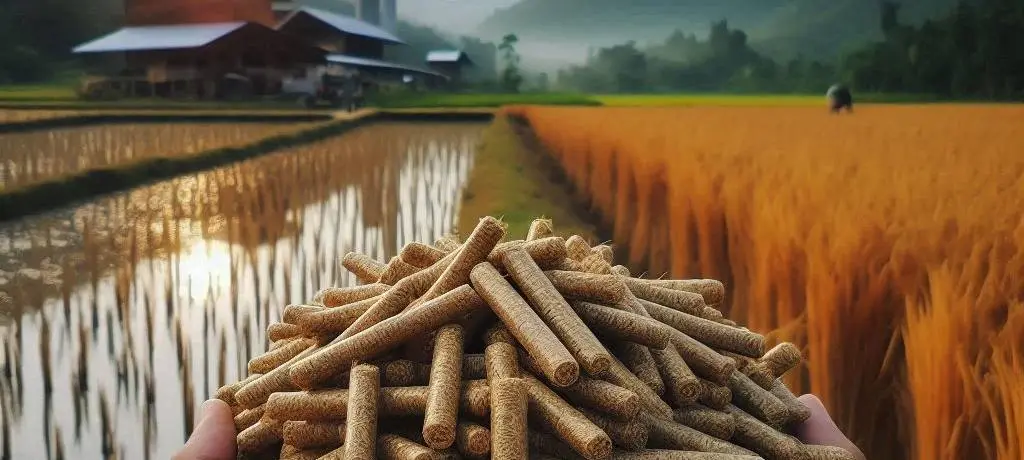
🔥 How Can You Improve the Quality and Profitability of Parali (Paddy Straw) Biomass Pellets? 💰♻️🌾
Making Biomass Pellets from Parali (Paddy Straw): Challenges, Solutions & Cost Analysis
Challenges of Parali Pelletization
1️⃣ Low Lignin Content:
- Lignin acts as a natural binding agent in pelletization.
- Parali has lower lignin than wood or other biomass, making pellets fragile without an external binder.
2️⃣ High Silica Content:
- Paddy straw contains high ash (15-20%), mostly due to silica.
- High silica content leads to:
✔ Poor pellet durability (fragile and brittle pellets).
✔ High wear & tear on pellet mill dies and rollers.
✔ Slagging issues in combustion, reducing efficiency.
Solutions to Improve Parali Pellet Quality
✅ Mixing with High-Lignin Biomass – Adding bagasse, sawdust, wood chips, mustard stalk improves binding.
✅ Using Binders – Molasses, starch, or lignosulfonates enhance pellet durability.
✅ Pre-Treatment – Torrefaction or steam explosion reduces silica content and enhances fuel quality.
Ideal Formulation for Durable Parali-Based Pellets
1. Blended Biomass Formulation (Best for Strength & Durability)
✅ Recommended Mix (by weight):
- Parali (Paddy Straw): 60%
- Bagasse / Sawdust / Wood Chips: 30% (high lignin for better binding)
- Mustard Stalk / Cotton Stalk: 10% (increases pellet density)
✅ Benefits:
✔ Stronger pellets with better water resistance.
✔ Lower silica content reduces machine wear & slagging.
✔ Higher calorific value (4,000-4,200 kcal/kg).
2. Binder-Based Formulation (If No Other Biomass Available)
✅ Recommended Mix:
- Parali (Paddy Straw): 95%
- Binder (Molasses, Starch, or Lignosulfonate): 5%
✅ Benefits:
✔ Stronger pellets without additional biomass.
✔ Improved durability & reduced dust.
✔ Works for 100% paddy straw pellet production.
🔴 Drawback: Slightly higher cost due to binder usage.
3. Pre-Treated Parali Pellets (For Low Ash & Better Combustion)
✅ Process Before Pelletization:
✔ Steam Explosion – Breaks lignin structure for better binding.
✔ Torrefaction (200-300°C) – Reduces silica & increases energy value.
✅ Benefits:
✔ Strong pellets without additives.
✔ Lower ash content (~8-10%).
✔ More energy-dense (~4,500 kcal/kg).
Key Considerations for Pellet Production
1️⃣ Moisture Content: Maintain 10-12% for optimal binding.
2️⃣ Grinding Size: Fine particles (3-5mm) ensure uniform pelletization.
3️⃣ Die Selection: Use a chrome alloy ring die for high-silica material.
4️⃣ Cooling & Storage: Proper cooling prevents cracks & ensures durability.
Cost Analysis for Parali-Based Pellet Production
1. Blended Biomass Formulation (Parali + Bagasse/Sawdust)

✅ Mix:
- Parali (Paddy Straw) – 60%
- Bagasse/Sawdust/Wood Chips – 30%
- Mustard Stalk/Cotton Stalk – 10%
✅ Estimated Cost Breakdown (per ton)
| Cost Component | Price (₹/ton) | Cost Contribution (₹) |
| Parali (Paddy Straw) | ₹1,500 | ₹900 |
| Bagasse/Sawdust | ₹2,500 | ₹750 |
| Mustard/Cotton Stalk | ₹2,000 | ₹200 |
| Electricity (80 kWh) | ₹10/kWh | ₹800 |
| Maintenance & Wear | ₹400 | ₹400 |
| Labor & Misc. | ₹300 | ₹300 |
| Total Cost | ₹3,350/ton |
✅ Final Price & Benefits:
✔ Pellet Selling Price: ₹5,000/ton
✔ Profit Margin: ₹1,650/ton (~33%)
✔ High durability for industrial & power applications
✔ Lower machine wear due to reduced silica
2. Binder-Based Formulation (100% Parali + Molasses/Starch)
✅ Mix:
- Parali (Paddy Straw) – 95%
- Binder (Molasses/Starch) – 5%
✅ Estimated Cost Breakdown (per ton)
| Cost Component | Price (₹/ton) | Cost Contribution (₹) |
| Parali (Paddy Straw) | ₹1,500 | ₹1,425 |
| Binder (Molasses) | ₹4,500 | ₹225 |
| Electricity (90 kWh) | ₹10/kWh | ₹900 |
| Maintenance & Wear | ₹700 | ₹700 |
| Labor & Misc. | ₹300 | ₹300 |
| Total Cost | ₹3,550/ton |
✅ Final Price & Benefits:
✔ Pellet Selling Price: ₹5,000/ton
✔ Profit Margin: ₹1,450/ton (~29%)
✔ Medium durability, but slightly brittle
✔ Higher machine wear due to silica
3. Pre-Treated Parali Pellets (Steam Explosion / Torrefaction)
✅ Process:
- Steam Explosion OR Torrefaction (200-300°C) before pelletizing
- Reduces silica & improves calorific value
✅ Estimated Cost Breakdown (per ton)
| Cost Component | Price (₹/ton) | Cost Contribution (₹) |
| Parali (Paddy Straw) | ₹1,500 | ₹1,500 |
| Electricity (120 kWh) | ₹10/kWh | ₹1,200 |
| Maintenance & Wear | ₹500 | ₹500 |
| Torrefaction Process | ₹500 | ₹500 |
| Labor & Misc. | ₹300 | ₹300 |
| Total Cost | ₹4,000/ton |
✅ Final Price & Benefits:
✔ Pellet Selling Price: ₹6,500/ton
✔ Profit Margin: ₹2,500/ton (~38%)
✔ Very high durability, ideal for export & industrial use
✔ Improved machine life due to reduced silica impact
Summary & Best Recommendations
| Formulation | Cost (₹/ton) | Selling Price (₹/ton) | Profit Margin (₹/ton) | Pellet Strength | Machine Wear |
| Blended (Parali+Bagasse) | ₹3,350 | ₹5,000 | ₹1,650 (33%) | High | Low |
| 100% Parali + Binder | ₹3,550 | ₹5,000 | ₹1,450 (29%) | Medium | High |
| Torrefied Parali Pellets | ₹4,000 | ₹6,500 | ₹2,500 (38%) | Very High | Medium |
✅ Best for Profit & Durability: Torrefied Parali Pellets
✅ Best for Lower Cost & Machine Safety: Blended Biomass Pellets
✅ Best for Simplicity: 100% Parali + Binder


📞 Contact Us for Biomass Solutions
📍 Servoday Plants & Equipments Limited
📞 +91 9427210483 | +91 9427210484
📧 sanjay@servoday.in
🌐 www.PelletIndia.com
👤 Contact Person: Sanjay Masuria
📲 WhatsApp: +91 9427210483

